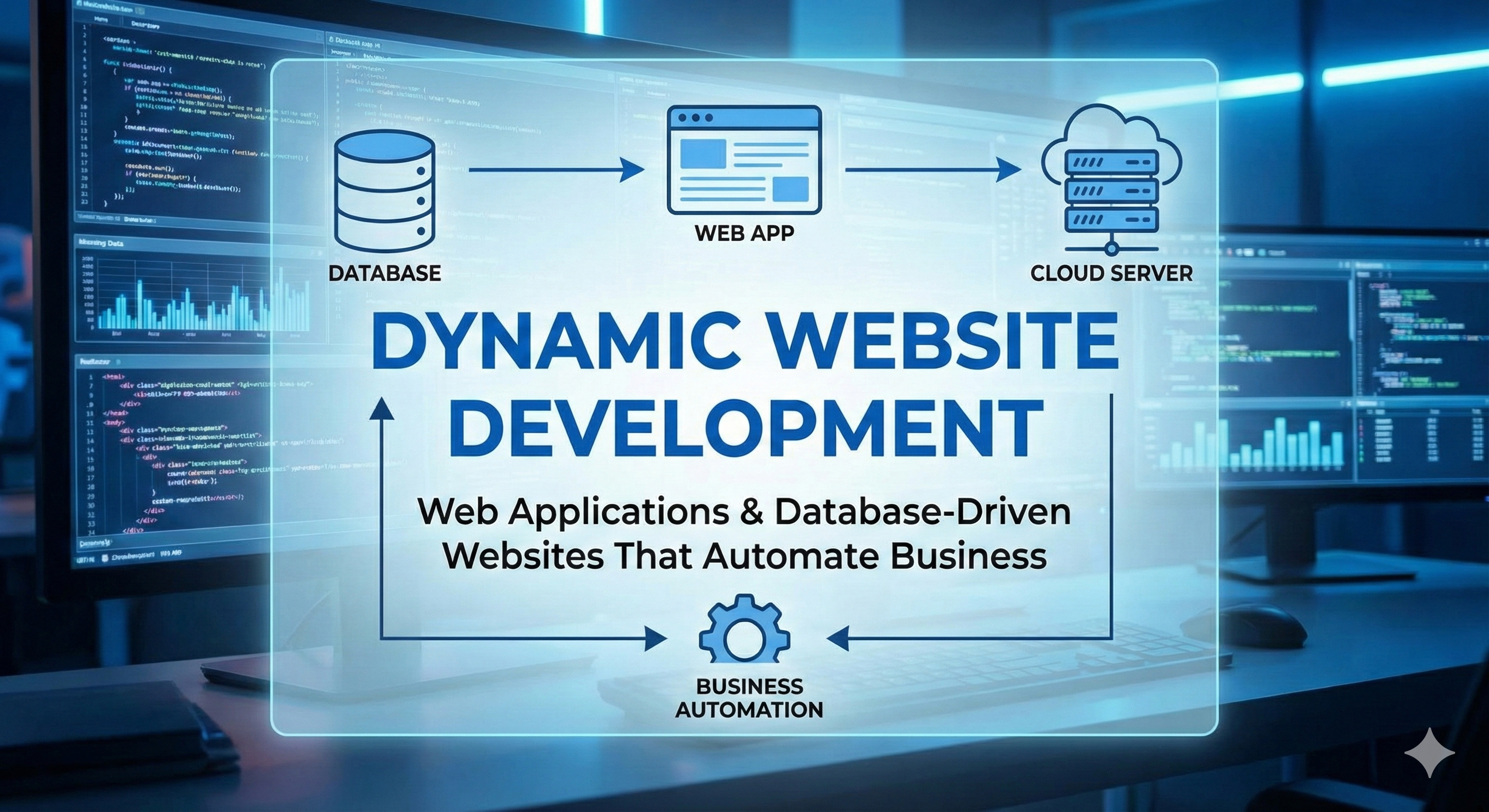
Dynamic Website Development
Web Applications & Database-Driven Websites That Automate Business
Fortune IT Corp builds secure, data-driven web applications and dynamic websites for startups, SMEs and enterprises since 2013. We focus on automation, scalability and measurable business outcomes.
Serving Mumbai, Thane, Navi Mumbai, Pune, Gujarat — clients in USA, UK, Europe, Canada, Singapore & Malaysia.
What is a Dynamic Website?
A dynamic website generates pages on demand using server-side code and a database. Content, user accounts and application logic are produced from templates and data — enabling personalised content, forms, dashboards and interactive features that a static site cannot provide.

Benefits of Dynamic Website Development
Easy Content Management
Editors and content teams update pages and assets using an admin panel or CMS, reducing publishing friction.
Database-Driven Functionality
Persistent storage for customers, products, orders and analytics enables reports and personalised experiences.
Process Automation
Automate emails, notifications, reports and CRM handoffs to reduce manual work and increase reliability.
Scalability
Architect systems to scale services and databases independently as demand grows.
Personalisation
Serve role- and segment-specific content to increase relevance and conversions.
Improved Engagement
Interactive features and dynamic content keep users active and returning.
Our Dynamic Website Development Services
We deliver production-ready dynamic websites and web applications backed by secure architecture and maintainable code.
Custom dynamic website development and web applications
Admin panel & dashboard development for internal operations
CMS-based and custom CMS implementations
User login, authentication & role-based access control
Forms, data collection and reporting
API integrations and third-party services
Features Included
Everything you need for a robust, scalable, and secure dynamic website or web application.
Admin Panel
Role-based admin interfaces for editors and operators.
Database Integration
Relational data models, backups and migrations.
User Management
Authentication, password reset and access controls.
Forms & Data Storage
Secure data capture and validation with export capabilities.
Search & Filters
Fast searches and faceted filters for content-heavy sites.
API Integration
Connect payments, CRMs and analytics for automation.
SEO-Ready Dynamic Websites
Dynamic sites can rank strongly when built with SEO best practices. We ensure crawlability, structured data and fast load performance so your pages are discoverable and indexable.
SEO-friendly URLs
Clean, human-readable URLs with canonicalisation and redirect rules.
Server-side / Hybrid Rendering
Server-side or hybrid rendering for critical pages to ensure bots can crawl content.
Schema Markup
Structured data (Organization, Breadcrumbs, FAQ) to improve SERP features.
Meta & Title Management
Dynamic meta tags and title templating per page or content type for better relevance.
Performance Optimisations
Caching, query tuning and CDNs to reduce load time and improve Core Web Vitals.
Sitemaps & Robots
Auto-generated XML sitemaps and robots rules so search engines find and prioritise pages.
Security, Performance & Scalability
Authentication & RBAC
Secure login, MFA options and fine-grained access control.
Data Validation & Encryption
Protect data in transit and at rest.
Performance
Caching layers, optimized queries and CDN delivery.
Scalability
Microservices, horizontal scaling and database partitioning when required.
Technology Stack & Expertise
We use proven technologies that balance developer productivity and long-term maintainability:
PHP & Laravel
For robust server-side applications
MySQL or PostgreSQL
For relational data
HTML, CSS, JavaScript
Vanilla or modern frameworks for front-end
REST / GraphQL APIs
For integrations
Development Process
1
Requirement Analysis
Capture workflows, actors and success metrics.
2
Database & Architecture Planning
Design scalable schemas and APIs.
3
UI/UX Design
Wireframes and interactive prototypes for key flows.
4
Development
Iterative sprints with automated tests and code reviews.
5
Testing & QA
Functional, security and performance testing.
6
Deployment
CI/CD, container or managed hosting and monitoring setup.
7
Support & Upgrades
SLA-based maintenance and feature roadmaps.
Frequently Asked Questions
A dynamic website generates content in real-time using server-side code and databases. Pages can display personalized, interactive, or frequently updated information, unlike static sites which show the same content to every visitor.
Dynamic websites are ideal for businesses that need frequent updates, user logins, e-commerce, dashboards, or interactive features. They offer flexibility, automation, and scalability for growing organizations.
Any business or organization that requires content management, user interaction, data collection, or custom workflows will benefit from a dynamic website. Examples include e-commerce, portals, membership sites, and web apps.
Dynamic websites are better for complex, interactive, or frequently updated needs. Static sites are faster and simpler for basic informational pages. The best choice depends on your goals and content needs.
Yes! Dynamic websites include admin panels or CMS, allowing you to update content, images, and features without coding knowledge.